By Drew Blattert, Owner and Grower, Pollen to Petal
If you’ve ever driven through most Southwest Missouri neighborhoods, you’ve probably seen it:
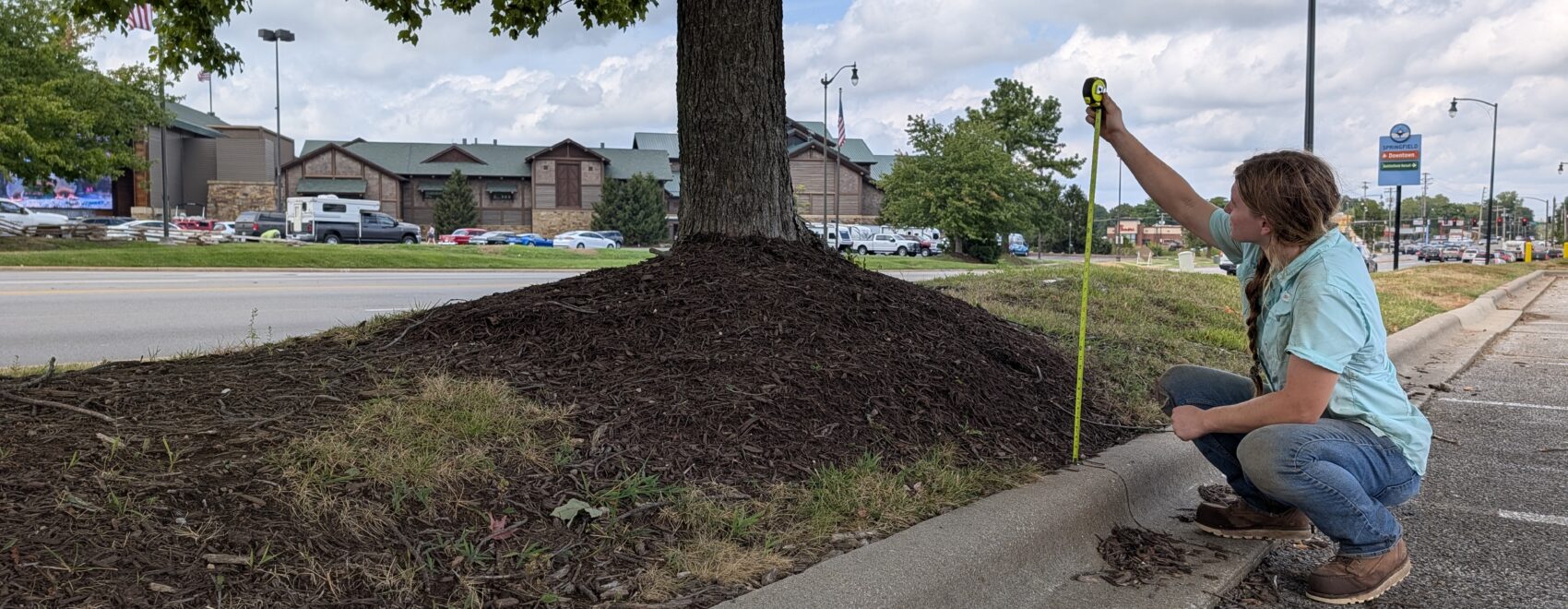
A tree trunk disappearing into a tall, cone-shaped pile of mulch.
Although it looks tidy, that “mulch volcano” is one of the most common mistakes homeowners make when caring for trees.
Mulch itself isn’t the problem. When applied correctly, it’s one of the simplest ways to support tree and plant health in our region’s heavy clay soils.
The key is knowing what kind of mulch to choose and how to apply it.
Here are three important tips our team at Pollen to Petal wants you to know before you reach for the wheelbarrow this season.
#1: Don’t Skip Mulching Altogether
It’s tempting to think of mulch as merely decorative, like a finishing touch for your lawn rather than a necessity.
In reality, a properly applied layer of mulch goes a long way toward maintaining the health of your trees and other vegetation.
- It helps plants beat the heat. A protective layer slows evaporation from the soil, which means less watering.
- It suppresses weeds. Mulch won’t eliminate weeds entirely, but it blocks the sunlight weed seeds need to germinate, cutting down on weeding time and herbicide use.
- It breaks up compacted, clay-heavy soil. Much of Southwest Missouri sits on dense clay. As organic mulch decomposes, it feeds nutrients back into the soil and gradually improves its structure.
- It protects against erosion and temperature swings. A good mulch layer regulates soil temperature, cushions against heaving during freeze-thaw cycles, and slows erosion and stormwater runoff.
Emma Verburgt, tree specialist at Pollen to Petal, sees the difference firsthand in the trees she works on. “Mulch has many benefits for your trees, young and old,” she says.
These benefits include helping young trees that are still establishing their roots. Without mulch, they may be more susceptible to winter freezing, summer dehydration, and erosion, which could expose young roots to damage above the ground.
#2: Choose the Best Mulch for Tree Health
Not all mulch is created equal. In fact, some of the most popular varieties can actually do more harm than good.
Skip These Materials
Sa’dia Luallen-Blattert, landscape designer and Grow Native! Certified Professional at Pollen to Petal, has seen the fallout from homeowners who made the mistake of using the wrong mulch. “It’s important to be aware of the pitfalls associated with different materials.”
- Recycled rubber mulch. While giving old tires a new life as recycled rubber mulch seems great on the surface, the ugly truth is, this rubber leaches hydrocarbons, heavy metals, and other chemical additives that neither you nor your plants should be exposed to. It’s also highly flammable and adds no nutrients to the soil.
- Recycled pallet mulch. Often produced from shipping pallets treated with industrial chemicals, pallet mulch is another unhealthy material that you don’t want breaking down near your root systems.
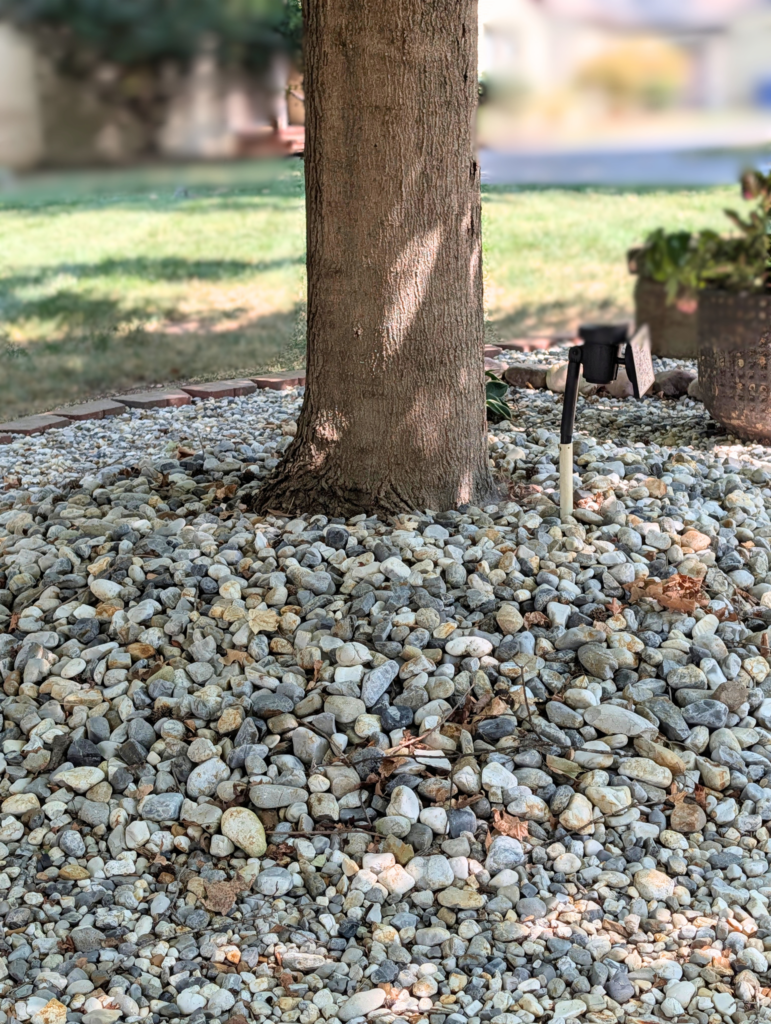
- Rock and gravel. Rock is durable and looks tidy, but it acts as a heat sink, absorbing and radiating heat that can stress roots and stems. It also requires landscape fabric that, over time, traps organic debris and promotes the very weeds it was meant to prevent.
Choose Organic Wood Mulch
Across the board, our experts recommend organic wood mulch.
That’s because it offers so many benefits. “It is readily available, cost effective, and works well for flowers, shrubs, and trees,” Sa’dia explains.
Here are a few common types of organic mulch:
- Wood chips. Larger, chunky pieces that take two to three years (or more) to decompose. Their irregular shape keeps the layer permeable, letting water reach tree roots without compacting into a solid mat.
- Pine mulch. This includes needles, bark, or a mix of both. Pine mulch provides excellent drainage and typically lasts around two years; the fine needles interlock well enough to hold up against heavy rain.
- Organic/compost-based mulch. A blend of materials like grass, straw, compost, and shredded wood that breaks down within about a year, delivering quick nutrients to the soil. Finer textures suppress weeds and retain water well, but shouldn’t be piled so thick that it compacts into an impenetrable layer.
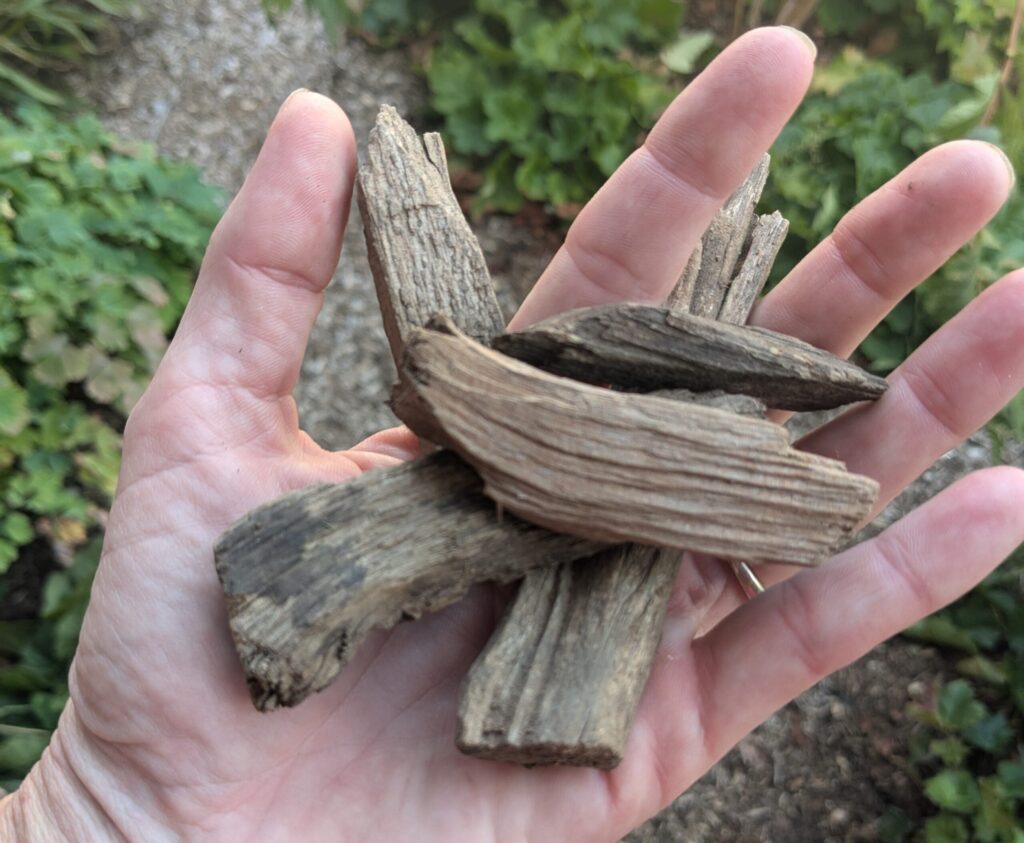
Emma notes that all of these mulches can be used for trees, shrubs, and flowers. For example, organic mulches may help with extra weed suppression in flower beds, while pine mulch provides airflow for trees.
“It really just depends on what you prefer, and what your specific plant needs.”
Hardwood mulches from trees like walnut, maple, hickory, and birch tend to be denser and more rot-resistant, but they break down more slowly and can raise soil alkalinity. This makes them a poor choice for acid-loving plants.
Softwood mulches, including pine, spruce, or cedar, are lighter, less expensive, and naturally increase soil acidity as they decompose.
At Pollen to Petal, our go-to is composted, fine-ground wood mulch sourced locally from yard-waste recycling. It’s made from a mix of hardwood and softwood tree and brush debris, holds water well, resists blowing or washing away, and gives your landscape a clean, dark, uniform look.
#3: Donut, Not Volcano: The Correct Way to Apply Mulch
Even the best mulch, when applied the wrong way, can hurt more than it helps.
That cone piled up against a trunk, also known as the “mulch volcano,” is a common mistake our experts see constantly.
Start by Finding the Root Flare
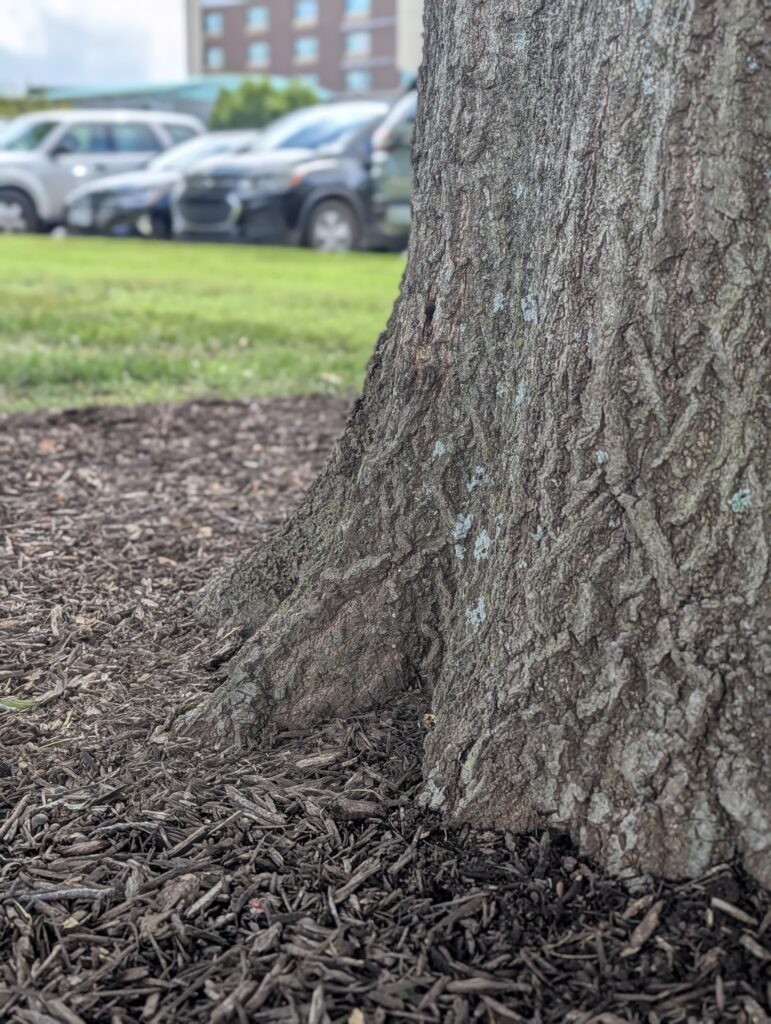
Before you spread a single scoop, locate your tree’s root flare. That’s the vase-like zone near the base of the trunk where it widens and transitions into the roots.
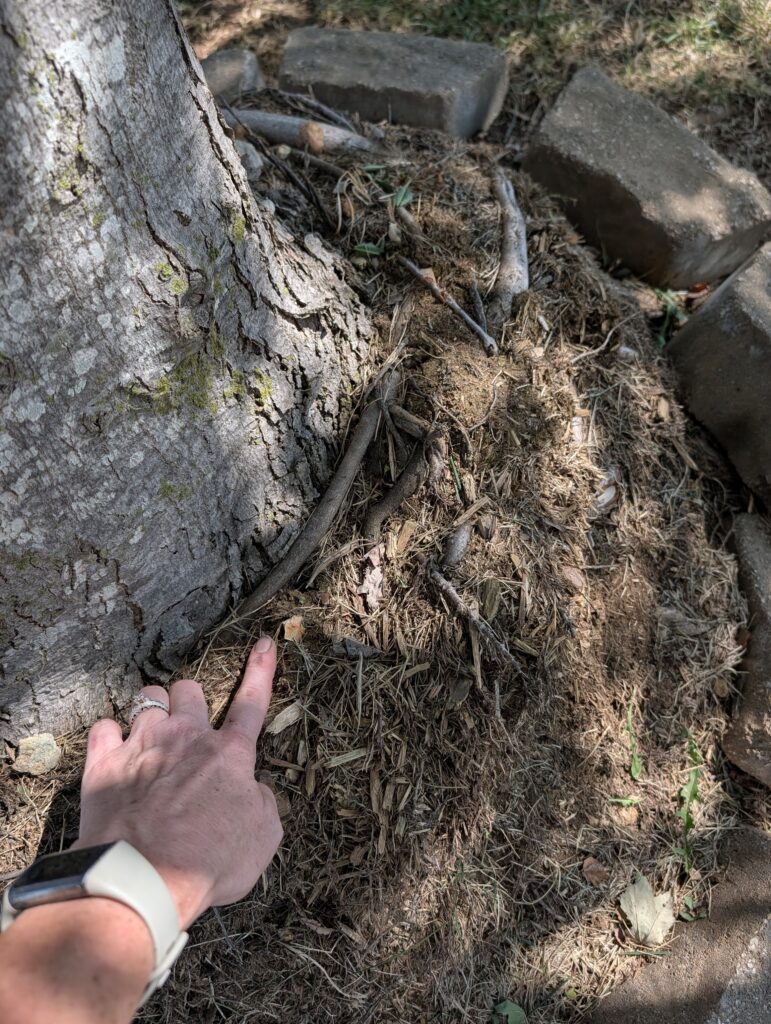
“The root flare should always be visible,” Emma explains, “so if yours is already covered by soil, I recommend carefully digging down until you find it!”
When the flare is covered by soil or mulch, a few problems can occur:
- The bark around the root flare may grow too moist and rot.
- Girdling, in which small roots sprout above-ground and gravitate towards the top of the volcano, suffocating the tree trunk as it grows outward.
Sa’dia describes the root flare as a buffer zone between two systems that need very different conditions.
“Roots live under the soil taking up water and nutrients for use in the plant,” she says. “Trunk bark protects the upper portions of the tree from rot, pest and disease.”
How to Build a Proper Mulch Donut
Instead of the volcano, apply your mulch in a donut shape. This pattern keeps the trunk free to breathe, insulates the root system, and retains soil moisture.
- Clear and prep the area. Remove weeds, sticks, and dead leaves. If you’re working over an old bed, define clean edges with a flat spade so mulch doesn’t spill onto the lawn.
- Water first. If the bed is dry, give it a deep watering before mulching to lock in moisture underneath the new layer.
- Keep mulch off the trunk. Leave a gap of roughly six inches around a tree’s trunk (two to three inches for smaller plant stems) so the root flare stays exposed to air.
- Spread, don’t pile. Distribute mulch in small, even scoops using a wheelbarrow, bucket, or shovel, then rake it smooth into a level layer, Work from the back of the bed forward so you’re not walking over freshly spread mulch.
- Aim for the right depth. A layer of about two to three inches is generally right for garden beds. Trees and shrubs can typically support a slightly deeper layer, especially heading into fall. Avoid over-mulching, which can suffocate soil-nesting native bees and other beneficial insects.
- Taper the edges. Feather the mulch down to ground level at the edge of the bed so it doesn’t bury low-growing or border plants, and so it’s easy to run a string trimmer along the perimeter.
- Extend to (but not past) the dripline. Spread the mulch ring out a few feet in diameter, ideally staying within your tree’s dripline rather than mulching the entire yard.
Done this way, mulch becomes a donut, offering a ring of protection around the tree, not a cone smothering it.
Need Help with Your Mulch Refresh?
Whether you’re mulching a newly planted native tree or fixing a volcano that’s been building for years, applying the right mulch in the right way protects the investment you’ve already made in your landscape.
If you’re not sure which type of mulch to choose, or how to apply it, Pollen to Petal is here to help.
Reach out to us for a detailed site survey and recommendations on landscaping with native plants, choosing the right mulch, and protecting your investment for years to come!
Sources
- Grow Native!, Native Landscape Care Calendar
- Grow Native!, Certified Professionals
- Missouri Botanical Garden, Mulches Fact Sheet (PDF)
- Pollen to Petal, Mulching Matters (Aug. 2024)
- Pollen to Petal, Organic Wood Mulch: The Real MVP (Aug. 2024)